
Topics the FCRisk proposition is built to address.
FCRisk combines practical insight with evidence-led access to authoritative Financial Crime sources across sanctions, AML/CTF standards, jurisdiction risk, enforcement, remediation, data, technology and AI.
Official Financial Crime Sources
Direct access to curated sanctions, AML/CTF, jurisdiction-risk, guidance and enforcement sources from the issuing authorities.
Financial Crime Enforcement Intelligence
Evidence-led analysis of why Financial Crime controls fail — from official finding through root cause, data, technology and remediation.
Financial Crime Control Failure Framework
Eight back-tested failure lenses connecting risk scope, control boundaries, data, design, operations, decisions, assurance and sustainable remediation.
Financial Crime Risk Assessment & BWRA
How business-wide and customer risk assessment should translate into control scope, data, operating decisions and evidence — grounded in current FCA expectations.
Explore Financial Crime Risk Assessment →Control Effectiveness Diagnostic
Translate the evidence architecture into an eight-lens review of design effectiveness, operating effectiveness and evidence sufficiency.
Regulatory Change Intelligence
Primary-source-led analysis of what current regulatory developments mean for Financial Crime control objectives, data, technology, governance and effectiveness.
Cross-Case Failure Intelligence
Evidence-led synthesis of recurring control-failure mechanisms across transaction monitoring, data boundaries and remediation.
Why the Financial Crime decision chain breaks
Where the real failures sit between customer understanding, monitoring, investigation, challenge and escalation.
KYC, UBO & PEP review at scale
How to structure customer review, beneficial ownership logic, PEP treatment and risk refresh more credibly.
AI in Financial Crime defence
What AI can improve in onboarding, screening, monitoring, investigations and prioritisation — and what governance it still requires.
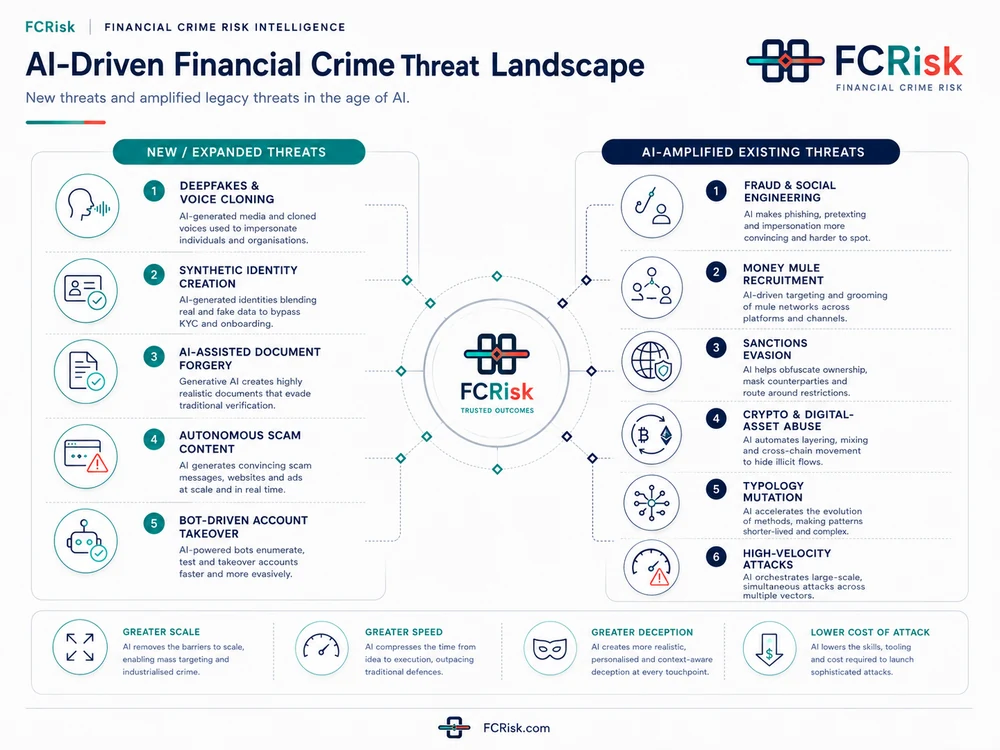
AI-amplified fraud and Financial Crime threats
Deepfakes, synthetic identity, mule recruitment, sanctions evasion and other rapidly evolving attack vectors.
Financial Crime technology proposition and bank-readiness
What providers often underestimate about data conditions, workflow reality, governance and buyer expectations.
Crypto and digital-asset AML questions
How crypto-related activity, provider coverage and typology awareness fit into broader AML control thinking.
UBS — regulatory & enforcement case note
Primary-source FinCEN and CFTC action illustrating data governance, monitoring configuration and remediation dependencies.
Intelligence Hub development sequence
Official Sources establishes the evidence gateway. Enforcement Intelligence adds case-level findings. The Control Failure Framework provides the eight-lens methodology. Cross-Case Intelligence synthesises recurring failure mechanisms. Regulatory Change Intelligence adds change-to-control analysis. The Control Effectiveness Diagnostic now converts that evidence architecture into a controlled advisory methodology.
The aim is a coherent evidence architecture rather than a high-volume news feed.