
Better Financial Crime outcomes depend on more than tooling.
FCRisk brings a bank-side perspective to the practical realities behind Financial Crime technology and AI decisions: data dependencies, control expectations, operating-model impact, governance, AI-enabled opportunity, AI-enabled threat and what enterprise buyers really need to see.
AI in Financial Crime defence
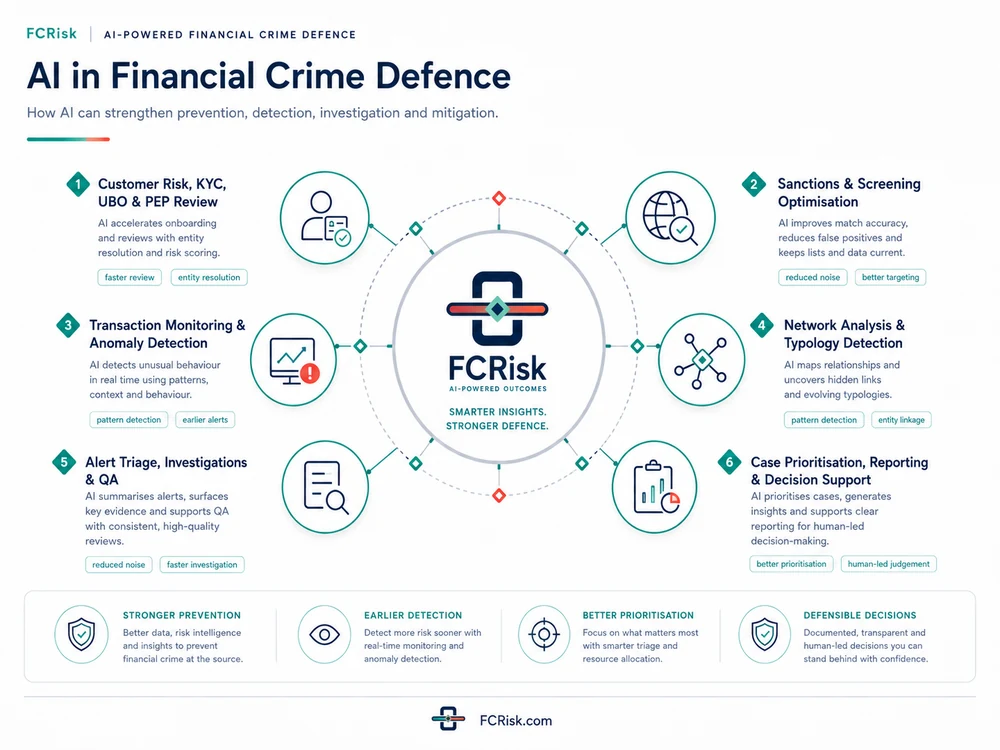
AI can strengthen prevention, detection, investigation and prioritisation when the surrounding operating model is strong enough to support it.
- Customer-risk, KYC, UBO and PEP review acceleration
- Sanctions and screening optimisation with lower false positives
- Transaction Monitoring, anomaly detection and network analysis
- Alert triage, investigations, QA support and decision reporting
- Improved prioritisation without removing human accountability
AI also changes the threat landscape.
The other side of the coin is equally important. AI lowers the cost of attack, increases speed and realism and helps old threats mutate faster.
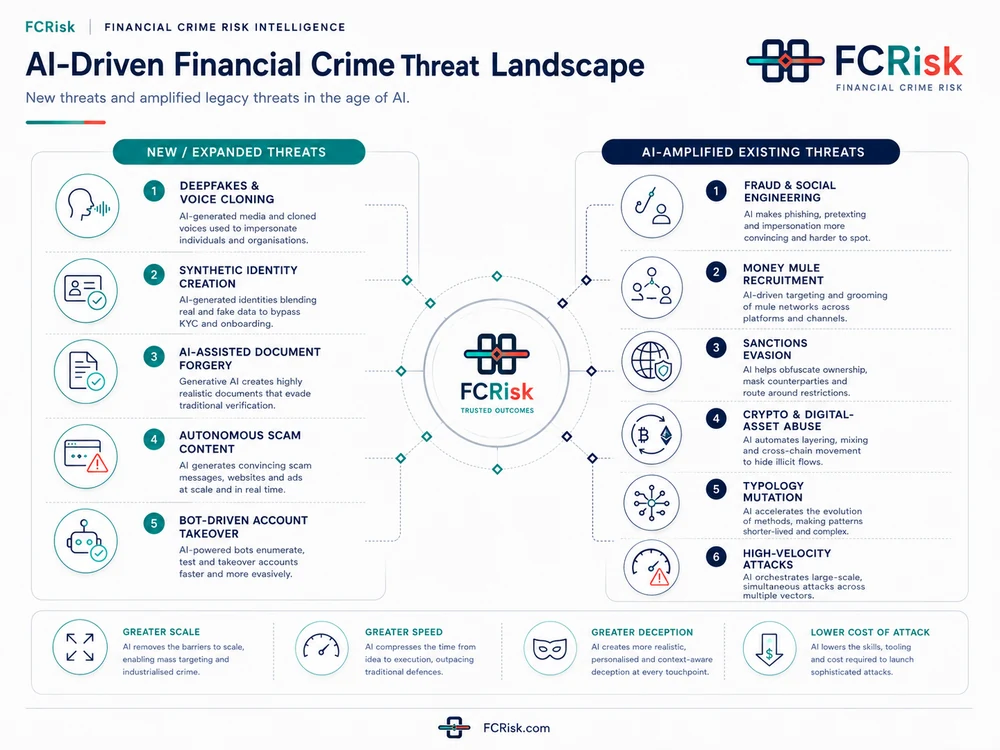
New and amplified threats
- Deepfakes and voice cloning
- Synthetic identity creation and AI-assisted document forgery
- Bot-driven account takeover and autonomous scam content
- AI-amplified fraud and social engineering
- Money-mule recruitment and sanctions-evasion tactics
- Crypto and digital-asset abuse at greater speed and scale
For many institutions the practical question is no longer whether AI matters, but how rapidly they can adapt controls, triage, governance and training.
Technology works best with strong judgement.
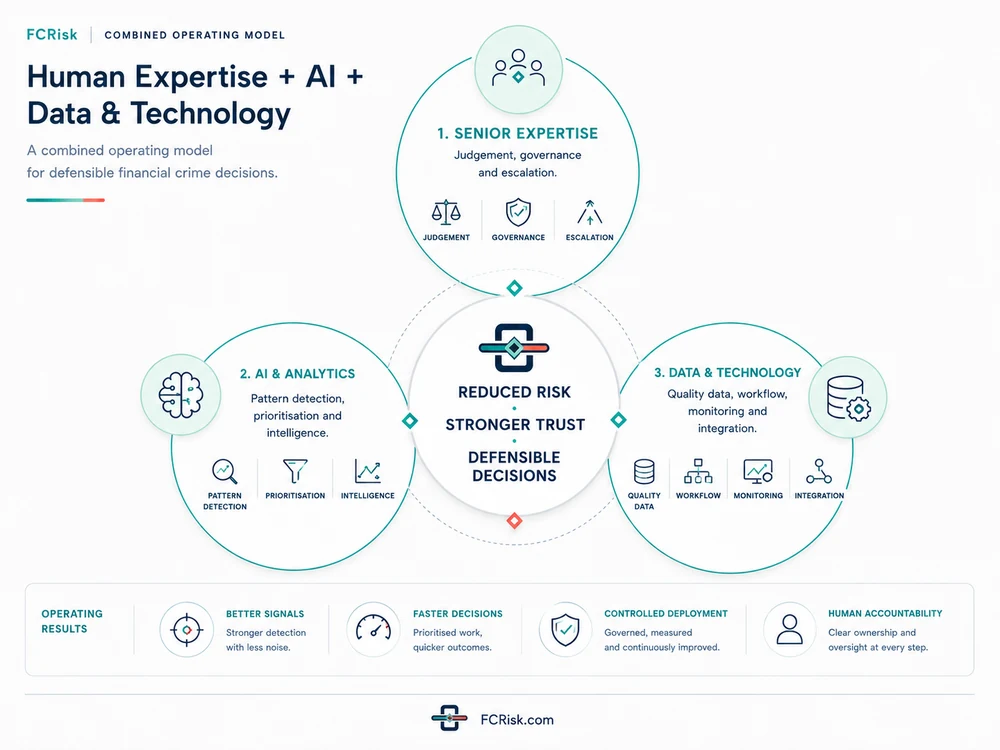
The aim is not to present AI as a magic layer. Stronger Financial Crime outcomes come from combining senior expertise, good-quality data, workable technology, clear governance and well-designed workflows.
- Senior expertise: judgement, challenge, escalation and governance
- AI and analytics: pattern detection, prioritisation and intelligence
- Data and technology: quality data, workflow, monitoring and integration
Defensible AI requires control and assurance.
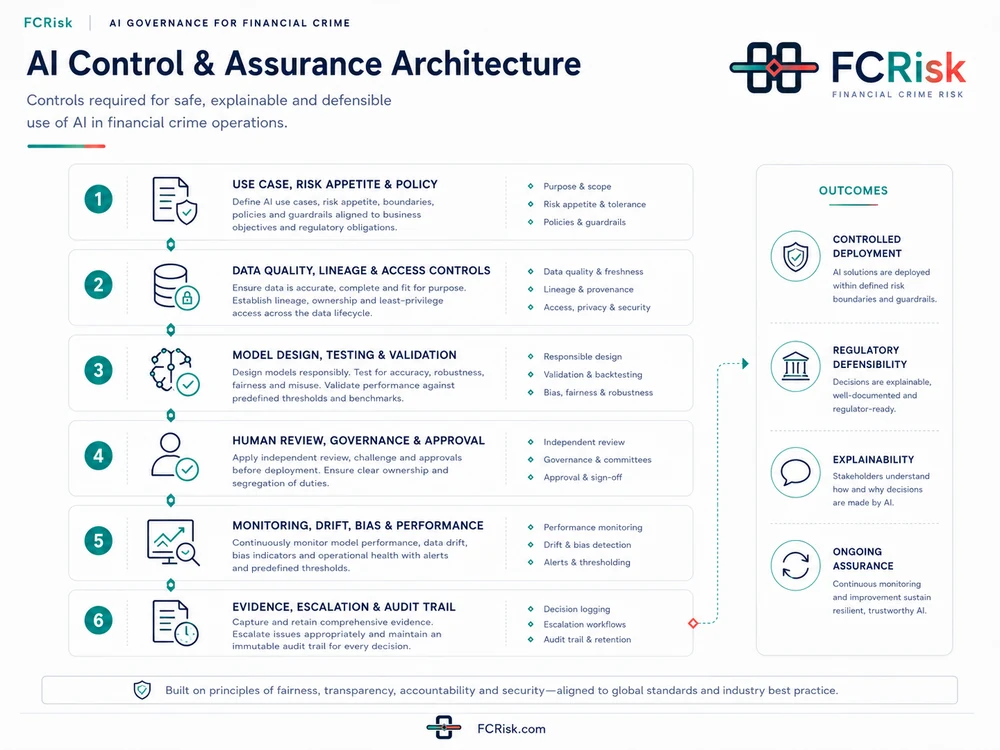
Adoption should be governed as seriously as any other decision-critical control environment. That means clear scope, data quality, testing, human review, monitoring and auditability.
- Use-case definition, risk appetite and policy alignment
- Data quality, lineage, privacy and access control
- Model design, testing, validation and bias review
- Human review, governance, approval and sign-off
- Monitoring, drift, thresholding and evidence retention
Financial Crime Technology Proposition & Bank-Readiness Review
Independent review of whether a technology, data or AI proposition is credible, implementable and defensible within a regulated financial institution.
Buyer expectation challenge
What a bank or regulated institution is likely to ask about governance, controls, explainability, integration, data and implementation practicality.
Data and control dependencies
Whether the proposition is realistic about the data conditions, screening lists, customer-reference data and control environment needed for success.
Operating-model impact
How the solution affects investigations, QA, workflows, assurance and decision ownership, not only model or detection performance.
Specific subject areas FCRisk can credibly cover
Relevant topics include customer-risk frameworks, KYC and UBO review, domestic and international PEP handling, sanctions and screening, Transaction Monitoring, investigations and QA, AML perspectives on cryptocurrencies and the strengthening of cryptocurrency and related-site coverage lists.
Direct bridge to DQIntegrity
Where the hard problem is data completeness, correctness, traceability or control evidence across the underlying data chain, FCRisk can connect directly into the specialist DQIntegrity proposition. Where the issue broadens into wider risk architecture or transformation, it can connect naturally to NFRisk.