
End-to-end remediation across customer risk, monitoring, investigations and escalation.
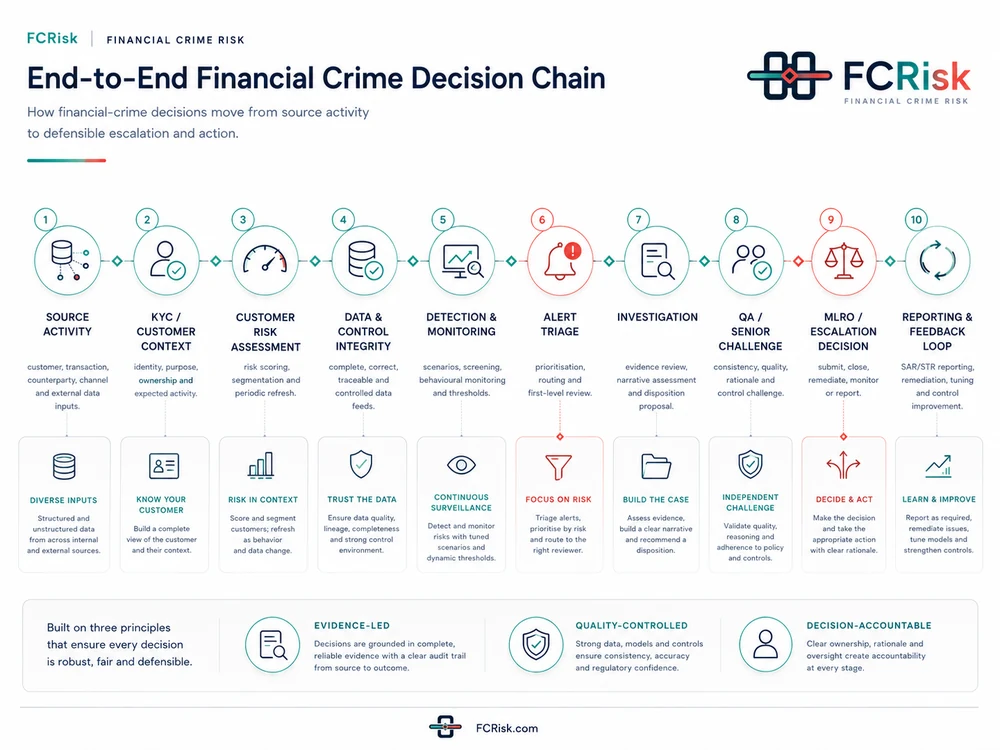
Correspondent Banking is a strong example of why Financial Crime controls need to be designed as a connected decision chain rather than as separate KYC, TM and investigation silos.
A full remediation operating model
Relevant experience includes designing and managing an end-to-end Correspondent Banking remediation operating model spanning customer and ownership review, UBO assessment, refreshed customer risk assessment using more than 40 data points, Transaction Monitoring alert generation, quality assurance, investigation review, second-stage challenge and escalation of residual cases to the MLRO.
The delivery model was multi-location, with approximately 45–50 resources across the Netherlands, Slovakia, Poland and Manila coordinated from London. That provides a practical basis for advising on remediation architecture, team design, quality gates, governance and defensible closure.
Customer understanding
Profile, ownership, UBOs, customer-risk factors and refresh.
Monitoring & investigation
Alert generation, case review, QA and secondary challenge.
Escalation & closure
Residual cases, MLRO escalation, evidence and governance.
What does an end-to-end Correspondent Banking AML remediation review cover?
Customer and ownership understanding
Customer profile, ownership, UBO, risk factors, KYC evidence and the quality of the refreshed customer-risk assessment.
Monitoring and investigation outcomes
Whether relevant data reaches TM, alerts are appropriately generated, investigations are adequately evidenced and QA identifies recurring weaknesses.
Escalation and closure
Whether residual cases reach the right decision-maker, remediation evidence supports closure and the operating model remains sustainable after the programme ends.